The Smartphone
smartphone. smartphones. smart phone. iPhone. Android. IBM Simon. Simon Personal Communicator. App Store. Android Market. T-Mobile G1. mobile phone. cell phone. what is a smartphone. what was the first smartphone. when did the iphone come out. when did android start. when did the app store open. is a smartphone a computer
🕰 1990s–2000s · ⏱ 7 min read
In one sentence: A smartphone is a mobile phone that is also a small computer, with an operating system and apps; the first one, says the Computer History Museum, came in 1993, and in 2007 Apple showed the iPhone, controlled with your fingers on a touch screen.
The world before
The first computers were huge. The Computer History Museum says they "were so heavy that the floor below sometimes needed reinforcing" (made stronger). Then came the personal computer: a computer that one person could own and use.
Mobile phones changed too. The museum says ordinary phones added new services, such as SMS texting. (SMS is a system for sending text messages.)
The first smartphone (1993)
A smartphone is a mobile phone that is also a small computer. Like a personal computer, it has a CPU (the part that carries out a program's instructions) and storage. It runs an operating system and programs called apps.
The museum calls the Simon, from the companies IBM and BellSouth, "the first smartphone". It dates the Simon to 1993. The Simon combined a mobile phone with the jobs of three other devices of the time. The museum says it "pioneered" (was one of the first in) "using a touchscreen instead of buttons for dialing and typing." (A touch screen is a screen that you can also touch to give the phone input.)
But the Simon was "brick-like" in weight and look, says the museum. You could talk on it for less than 30 minutes, and it cost $899. The museum calls it "unsuccessful".
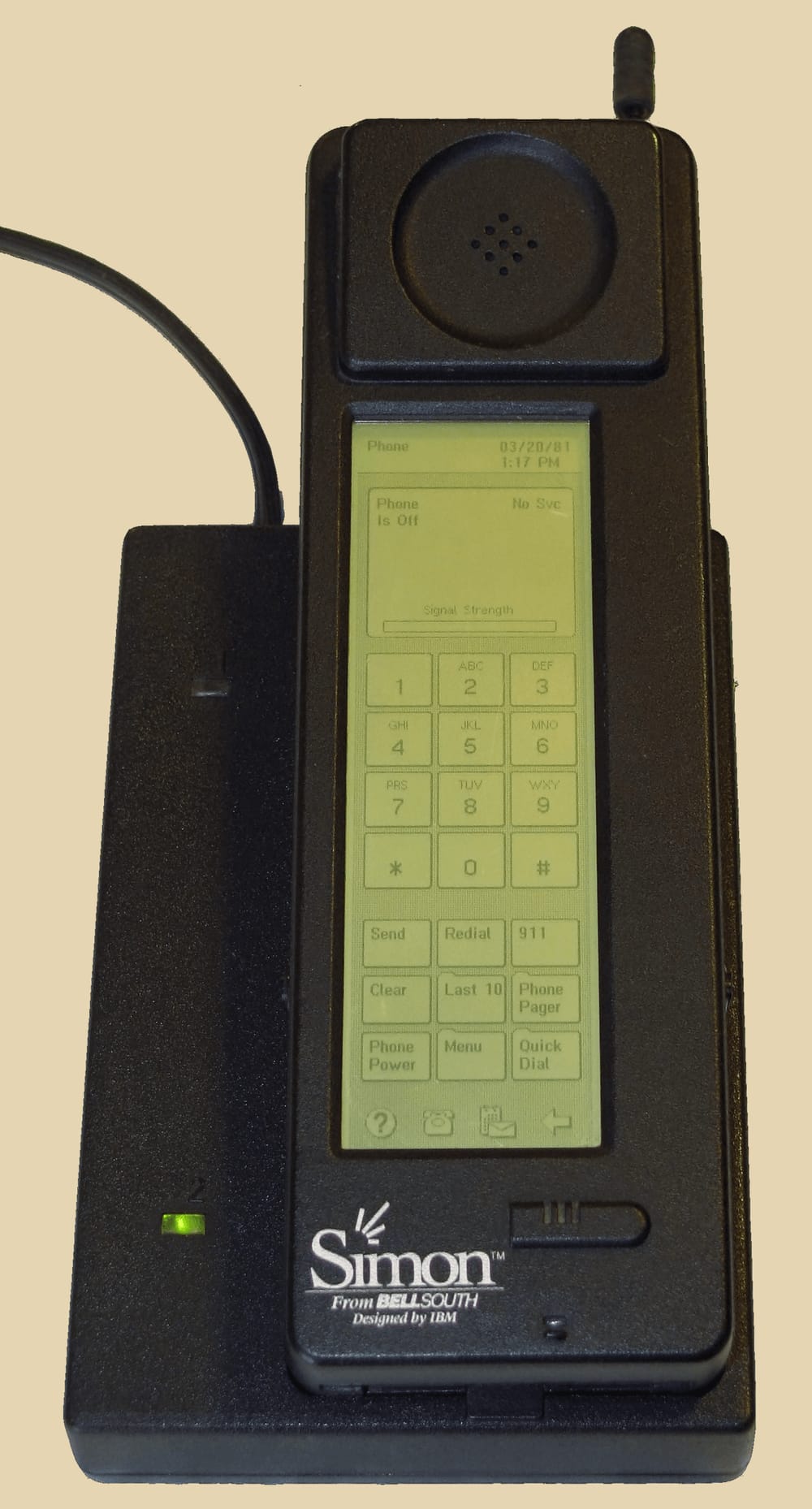 Touch screen

Smartphones before the iPhone
From 1999, the museum says, successful smartphones "began appearing from companies around the world, bringing the Web to your pocket": you could visit web pages on the phone.
What happened
The iPhone is announced (January 2007)
On January 9, 2007, at an event called Macworld in San Francisco, Apple showed the iPhone. You met Apple in the personal computer lesson. Steve Jobs, Apple's CEO (its chief executive), called it "a revolutionary and magical product".
Apple said the iPhone combined three products in one:
- a mobile phone,
- an iPod, Apple's music player, "with touch controls",
- a device for the internet, with email and a web browser called Safari.
Apple called the iPhone's large screen a multi-touch display. Apple said you could control the iPhone with your fingers alone. For example, you could flick a finger to scroll through a list of songs. To type, you used what Apple called a "soft keyboard": a keyboard drawn on the screen.
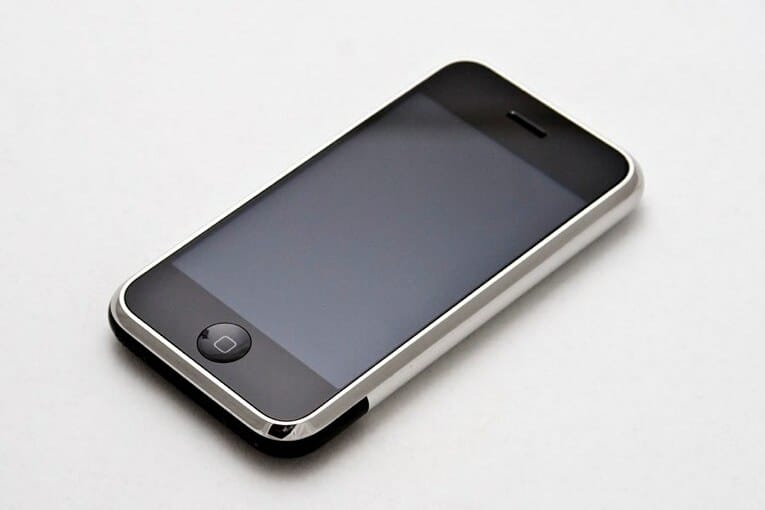 Touch screen

Apple's press release also listed a camera and three sensors: parts that measure something about the world. One of them, the accelerometer, noticed when you turned the phone on its side. Then the picture on the screen turned too.
On sale (June 2007)
The iPhone went on sale in the United States on June 29, 2007. Prices started at $499.
The App Store opens (July 2008)
In July 2008, Apple opened the App Store: a store for apps, built into the phone. Apple said it opened "with over 500 native iPhone applications" (apps made for the iPhone) from "hundreds of companies around the world".
Android (2007–2008)
On November 5, 2007, a group of 34 companies, including Google, announced Android. They called their group the Open Handset Alliance. They said Android would be "open", under an "open-source" license.
Android is an operating system for phones and other devices. Open source means that its source code (the program as people wrote it) is available to anyone, who may use it and change it. The Android project, led by Google, says anyone can use it "for any purpose".
On September 23, 2008, T-Mobile showed the T-Mobile G1, "the First Phone Powered by Android". It had a touch screen and also a real keyboard. It went on sale in the United States on October 22, 2008. On the same day, Android Market, Android's app store, opened with "over 50 apps".
Why it mattered
The Computer History Museum describes the change: "Today, computers slip into purses or pockets and are misplaced as easily as keys."
The smartphone is a computer. You can see in it the parts from How the Parts Work Together. The touch screen is input and output in one. And like a personal computer, it needs an operating system to start apps and share the CPU, memory and storage among them.
Those operating systems have deep roots. Today, the iPhone's operating system is called iOS. In the operating system lesson, you met Unix, from 1969. The museum lists Android and iOS among the "many descendants" of Unix: later systems built from it or modelled on it. Android's own guide calls Android "Linux-based": built on Linux. The museum lists Linux as a Unix descendant too.
App stores also gave developers (people who write Software and Programs) a new way to reach phone owners. Apple said developers could now sell their apps "right onto every iPhone".
The International Telecommunication Union (ITU) is a United Nations agency for information and communication technologies. In its 2025 figures, it says that "82 per cent of individuals 10 years or older own a mobile phone". That number counts all mobile phones, not only smartphones.
This lesson does not explain why some phones succeeded or failed.
🔍 See it for yourself
- Open the Computer History Museum's page on the IBM/BellSouth Simon. Look at the photo, then read the short description next to it. Find the words "the first smartphone" and the year the Simon was introduced.
- Open the museum's page Internet in Your Pocket. Look through the photo captions for the one that says "Original iPhone". On a computer, you can press Ctrl+F (Command+F on a Mac) and type Original iPhone to find it.
- Open Apple's 2007 press release, Apple Reinvents the Phone with iPhone. Find the three products that Apple said the iPhone combined.
What this shows: the Simon had a touch screen 14 years before the iPhone, but the museum calls it "unsuccessful".
On your own smartphone: you can see which operating system it runs. If you do not have a smartphone, skip this part. Only look; do not tap any button that installs an update.
- iPhone: open Settings, tap General, then Software Update. Apple says this screen shows "the currently installed version of iOS".
- Android phone: open the Settings app, then tap About phone and Android version. This is how Google's Android Help describes it. If you cannot find these menus, skip this step.
Recap
- A smartphone is a mobile phone that is also a small computer, with an operating system and apps. The museum calls the IBM/BellSouth Simon, from 1993, the first smartphone.
- Apple showed the iPhone, controlled with fingers on a multi-touch screen, on January 9, 2007, and opened the App Store in July 2008.
- Android, announced in 2007 and on the first phone in 2008, is an operating system whose source code anyone can use. The museum counts iOS and Android among the descendants of Unix.
Sources
- Computer History Museum, Revolution: Mobile Computing: https://www.computerhistory.org/revolution/mobile-computing/18
- Computer History Museum, Revolution: Phones Get Smart: https://www.computerhistory.org/revolution/mobile-computing/18/341
- Computer History Museum, IBM/BellSouth Simon Personal Communicator: https://www.computerhistory.org/revolution/mobile-computing/18/341/1733
- Computer History Museum, BellSouth Simon screen: https://www.computerhistory.org/revolution/mobile-computing/18/341/1704
- Computer History Museum, Revolution: Internet in Your Pocket: https://www.computerhistory.org/revolution/mobile-computing/18/398
- Computer History Museum, Timeline of Computer History, 2007: https://www.computerhistory.org/timeline/2007/
- Apple Newsroom, Apple Reinvents the Phone with iPhone (January 9, 2007): https://www.apple.com/newsroom/2007/01/09Apple-Reinvents-the-Phone-with-iPhone/
- Apple Newsroom, iPhone Premieres This Friday Night at Apple Retail Stores (June 28, 2007): https://www.apple.com/newsroom/2007/06/28iPhone-Premieres-This-Friday-Night-at-Apple-Retail-Stores/
- Apple Newsroom, iPhone 3G on Sale Tomorrow (July 10, 2008): https://www.apple.com/newsroom/2008/07/10iPhone-3G-on-Sale-Tomorrow/
- Open Handset Alliance, Industry Leaders Announce Open Platform for Mobile Devices (November 5, 2007): https://www.openhandsetalliance.com/press_110507.html
- T-Mobile, T-Mobile Unveils the T-Mobile G1, the First Phone Powered by Android (September 23, 2008): https://www.t-press.cz/en/tiskove-zpravy/-/releases/t-mobile-unveils-the-t-mobile-g1-the-first-phone-powered-by-android/7404318
- Android Developers Blog, Android Market now available for users (October 22, 2008): https://android-developers.googleblog.com/2008/10/android-market-now-available-for-users.html
- Android Developers, Platform architecture: https://developer.android.com/guide/platform
- Android Open Source Project, About AOSP: https://source.android.com/docs/setup/about
- Computer History Museum, The Earliest Unix Code: An Anniversary Source Code Release: https://computerhistory.org/blog/the-earliest-unix-code-an-anniversary-source-code-release/
- ITU, Facts and Figures 2025, Mobile phone ownership: https://www.itu.int/itu-d/reports/statistics/2025/10/15/ff25-mobile-phone-ownership/
- Apple Support, Update your iPhone or iPad: https://support.apple.com/en-us/118575
- Android Help, Check and update your Android version: https://support.google.com/android/answer/7680439?hl=en
- ITU, About ITU: https://www.itu.int/en/about/Pages/default.aspx
- Wikipedia, Smartphone (general background reference): https://en.wikipedia.org/wiki/Smartphone
Written with AI · Reviewed by AI · Not yet checked by a human
Found a mistake, or something you did not understand? Report a problem.