The Personal Computer
PC. personal computers. home computer. Altair 8800. Altair. IBM PC. IBM 5150. Apple II. TRS-80. Commodore PET. Kenbak-1. what is a personal computer. what was the first personal computer. what was the altair 8800. when did people start having computers at home. what was the ibm pc. why is it called a pc
🕰 1970s–1980s · ⏱ 6 min read
In one sentence: In 1975, the Altair 8800, a computer kit built around a microprocessor, helped start the personal computer: a computer that one person could own and use.
The world before
For a long time, computers did not belong to people. They belonged to large organizations. The Computer History Museum puts it this way: computers were made mainly "for military, scientific, government, and corporate users" with big needs and big budgets. They were in labs, universities and big companies, but rarely in homes or small businesses.
IBM was "the leading business computer manufacturer", says the museum. IBM's own history page says that, like many other companies at the time, IBM sold computers only to businesses.
Then the The Microprocessor arrived: a whole CPU (the part of a computer that follows a program's instructions) on one chip. The museum says Intel's 8080 microprocessor, from 1974, made it easier for individuals to build computers.
What happened
Hobbyists build their own
Many early personal computers were built by hobbyists: people who build electronics for fun, not as their job. They often worked from kits: boxes of parts that you put together yourself. They formed clubs to share tips. One was the Homebrew Computer Club ("homebrew" means homemade), which had its own newsletter.
Was there an earlier one?
Before 1975, a few small computers were already for sale. In 1986, The Computer Museum in Boston held a contest to find the first personal computer. The judges chose the Kenbak-1, designed in 1971 by John Blankenbaker. It was built before microprocessors, from many simpler chips. Only about 40 were sold. The title "first personal computer using a microprocessor" went to the Micral, from France, in 1973. It used Intel's 8008 chip.
The Altair 8800 (1975)
In its January 1975 issue, the hobbyist magazine Popular Electronics put a new computer kit on its cover: the Altair 8800. It was made by a company called MITS. The museum says that within weeks, customers "inundated" MITS with orders. (To inundate means to flood.)
The Altair used the Intel 8080 microprocessor. The museum's timeline for 1975 says it sold for $297, or $395 with a case. It came with 256 bytes of memory.
In its basic form, you programmed the Altair with rows of switches on its front. You set the switches to one instruction in Binary and stored it in memory. Then the next one, until the whole program was in. The only output was a pattern of red lights.
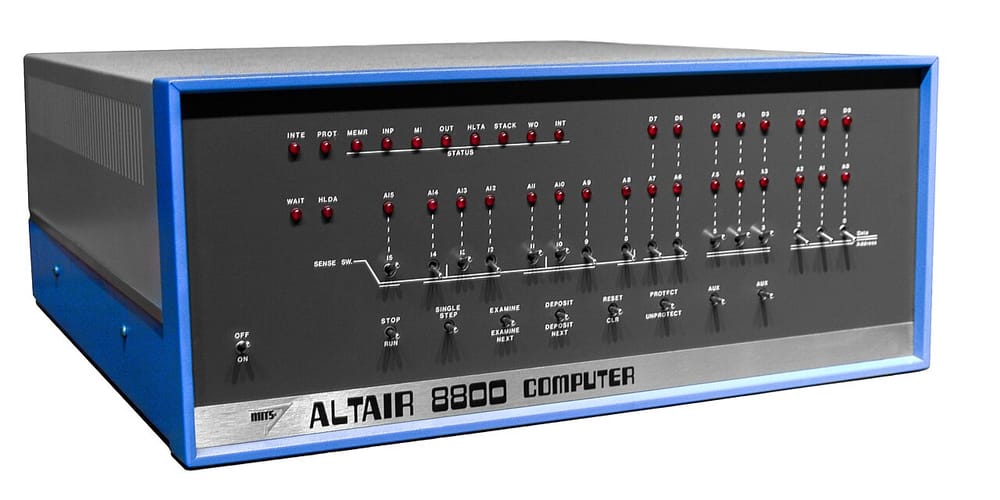 LightsSwitches

Ed Roberts, a co-founder of MITS, invented it. The museum's catalog says that many people credit the Altair with starting the personal computer revolution.
A new company: Microsoft
In 1975, Bill Gates contacted the makers of the Altair. He offered them software for BASIC, a programming language (a way of writing instructions for a computer). With this software, Altair owners could write their own programs in BASIC. MITS was interested, so Gates and his friend Paul Allen had to write the software. The museum says: "Microsoft was born."
Ready-made computers (1977)
The museum says that before 1977, most home computers were kits that needed technical skill. Then more companies began to sell computers that came already built. In 1977, three of them appeared: the Apple II, the TRS-80 and the Commodore PET.
You can see in them the parts from How the Parts Work Together. The TRS-80, for example, came with a microprocessor (the CPU), 4 KB of memory (about 4,000 bytes), a keyboard for input and a screen for output. For storage it used a cassette tape, a small tape like the ones once used for music. It cost $599.95. Its manuals assumed the user knew nothing about computers before. Tandy Radio Shack, the company that made it, sold 10,000 in the first month. It had expected to sell 3,000 in the first year.
Steve Wozniak designed the Apple II. Apple Computer, which he founded with Steve Jobs in 1976, sold it. It used a TV as its screen. The museum says "millions of Apple IIs were sold between 1977 and 1993."
The IBM PC (1981)
On August 12, 1981, IBM showed its own personal computer, the IBM PC, at a hotel in New York. Don Estridge led the team that made it. IBM says it was priced at $1,565, and for that it had 16 KB of RAM (about 16,000 bytes) and no disk drive. Adding a screen, two disk drives and a printer cost nearly $3,000 more. It used an Intel 8088 microprocessor. Microsoft provided its operating system: a program that starts when the computer starts up and manages the other programs. It later became known as MS-DOS.
Why it mattered
The museum sums up the change: "Individuals could now afford and understand computers, which dramatically changed everyday life."
The museum says schools were "a prime target" for most personal computer makers. Apple gave away thousands of Apple IIs to schools. The museum says this gave "a new generation their first access to personal computers."
The IBM PC changed offices. The museum says it was "the first PC to gain widespread adoption by industry." Companies bought PCs in large numbers. Other companies made clones: copies of the IBM PC that could run software written for it. So many computers followed IBM's design that, in IBM's words, it "became a standard". IBM adds that "PC became a generic term": a name for any personal computer, not only IBM's.
Growing PC sales also created a fast-growing market for software (programs). It included spreadsheets (programs for working with tables of numbers) and word processing (programs for writing documents). The story of personal computing continues in the The Smartphone lesson.
🔍 See it for yourself
- Open the Computer History Museum's page What Was the First PC?. Read the text about the 1986 contest. Then look at the photos on the page. Each photo has a short caption. Find the one that says "John Blankenbaker with the Kenbak-1 computer".
- Open the museum's 1975 timeline. Press Ctrl+F (Command+F on a Mac) and type Altair to find the entry "MITS Altair 8800 kit appears in Popular Electronics". Read the entry and look at the photo of the Altair next to it.
- Open the museum's page Personal Computers for the Masses. Look through the photo captions for the three computers of 1977: the TRS-80, the Commodore PET and the Apple II.
What this shows: the Kenbak-1 and the Altair had switches and lights. The 1977 computers came ready to use, each with a keyboard. On a phone, finding words on a page works differently.
Recap
- At first, computers were made for the military, scientists, governments and big companies. The microprocessor made it easier for individuals to build their own.
- The Altair 8800 kit, on a magazine cover in January 1975, is widely credited with starting the personal computer revolution. Earlier machines like the Kenbak-1 (1971) also have a claim to be first.
- Ready-made computers in 1977 and the IBM PC in 1981 brought personal computers to homes, schools and offices.
Sources
- Computer History Museum, Revolution: Personal Computers (introduction): https://www.computerhistory.org/revolution/personal-computers/17
- Computer History Museum, Revolution: Doing It Yourself: https://www.computerhistory.org/revolution/personal-computers/17/296
- Computer History Museum, Revolution: What Was the First PC?: https://www.computerhistory.org/revolution/personal-computers/17/297
- Computer History Museum, Revolution: Personal Computers for the Masses: https://www.computerhistory.org/revolution/personal-computers/17/298
- Computer History Museum, Revolution: Apple: https://www.computerhistory.org/revolution/personal-computers/17/300
- Computer History Museum, Revolution: The IBM PC: https://www.computerhistory.org/revolution/personal-computers/17/301
- Computer History Museum, Revolution: IBM PC clones: https://www.computerhistory.org/revolution/personal-computers/17/302
- Computer History Museum, Revolution: Software: https://www.computerhistory.org/revolution/personal-computers/17/305
- Computer History Museum, Timeline of Computer History, 1975: https://www.computerhistory.org/timeline/1975/
- Computer History Museum, Timeline of Computer History, 1977: https://www.computerhistory.org/timeline/1977/
- Computer History Museum, Timeline of Computer History, 1981: https://www.computerhistory.org/timeline/1981/
- Computer History Museum catalog, Altair 8800 Microcomputer: https://www.computerhistory.org/collections/catalog/X58.82/
- IBM History, The IBM PC: https://www.ibm.com/history/personal-computer
- Wikipedia, Altair 8800: https://en.wikipedia.org/wiki/Altair_8800
- Stanford CS101, Software: Running Programs: https://web.stanford.edu/class/cs101/software-1.html
Written with AI · Reviewed by AI · Not yet checked by a human
Found a mistake, or something you did not understand? Report a problem.