Before Computers: the Abacus and Mechanical Calculators
abacus. pascaline. pascal's calculator. step reckoner. stepped reckoner. arithmometer. mechanical calculator. history of calculators. what did people use before computers. what is an abacus. who invented the first calculator. what was the pascaline. how did mechanical calculators work. what did the word computer mean in the past
🕰 Ancient times – 1800s · ⏱ 5 min read
In one sentence: Long before today's computers, people did arithmetic with the abacus, and from the 1600s with mechanical calculators made of gears and wheels, such as Blaise Pascal's machine of 1642.
The world before
Imagine you run a shop, collect taxes or plan a ship's journey. You need to add, subtract, multiply and divide large numbers every day. This kind of work with numbers is called arithmetic. You have no calculator and no computer. A mistake can cost money.
For thousands of years, people did this with an abacus. An abacus is a counting tool. It has movable markers, such as beads on rods or stones on lines. Each column of markers stands for a value, like the "ones" column and the "tens" column when you write a number. You do arithmetic by moving the markers according to a few rules.
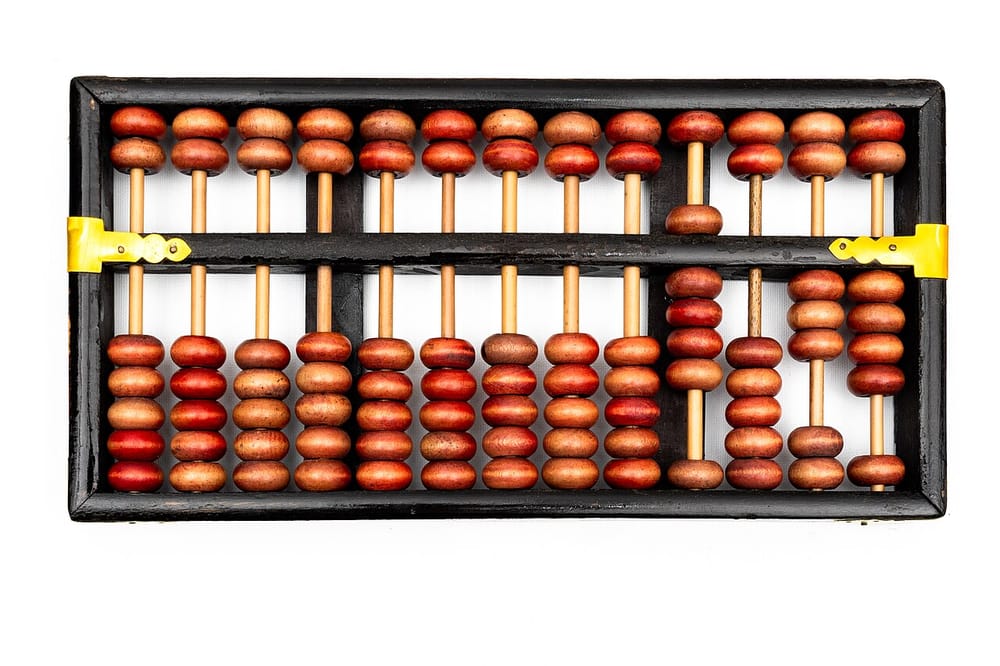 BeadRodBar

The Computer History Museum calls the abacus "perhaps the oldest continuously used calculating tool aside from fingers". Early versions were probably stones placed on lines drawn in the dirt. Later versions used beads on rods, or beans on a board or cloth. Abacuses were used from China to Greece to the Inca Empire. A marble table found on the Greek island of Salamis may be the oldest surviving calculating device.
In Europe, a flat counting board was common up to the 1700s. Shopkeepers faced their customers across it. According to the museum, this "counting board" is where the English word counter (the table in a shop) comes from.
There is one more surprise. For centuries, the word "computer" did not mean a machine. It meant a person: a clerk (an office worker) who did arithmetic, often as part of a team working on a big calculation.
What happened
The abacus helps you calculate, but you still do the thinking. In the 1600s, inventors began to build mechanical calculators: machines with gears and toothed wheels that do part of the arithmetic for you.
Around 1623: Wilhelm Schickard. Schickard, a university professor, built two calculators. One was for his friend, the astronomer Johannes Kepler, and was destroyed by fire. The other is lost. We know about them only from his letters and sketches. His machine used toothed wheels to add and subtract, and a set of number rods called Napier's Bones to multiply and divide. The Computer History Museum calls it "the earliest known mechanical four-function calculator". Four-function means it could add, subtract, multiply and divide.
1642: Blaise Pascal. Pascal was a mathematician and philosopher. His father was a tax collector. To help him, Pascal designed a calculating machine. According to the Science Museum Group, he completed the first one in 1642, when he was 19. Today it is called the Pascaline. You put a pointed stick (a stylus) into a toothed wheel at a number, then turned the wheel until it hit a stop. The machine was designed for adding and subtracting. According to the Computer History Museum, Pascal built about 50 of them, but he sold only about 15.
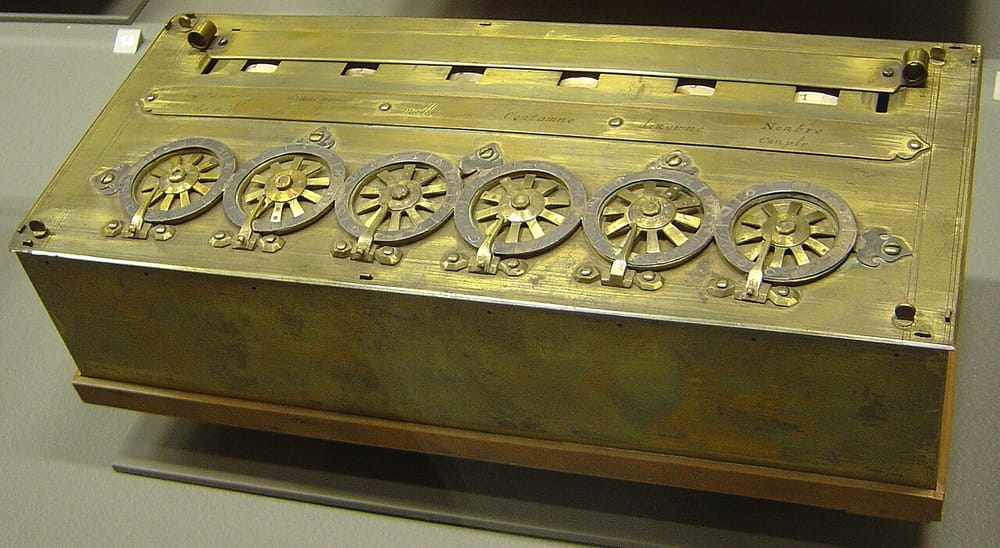 StopWheel
Image: David.Monniaux, CC BY-SA 3.0; resized 1673: Gottfried Leibniz. Leibniz built the Step Reckoner, a four-function calculator. Its new idea was a gear shaped like a drum with steps, called a stepped drum. In one turn, a single stepped drum could stand for any digit from 0 to 9. Leibniz built several versions over about 45 years. Only one survives today.
1820: Thomas de Colmar. Thomas de Colmar registered the Arithmometer as his invention in France in 1820. (This official record is called a patent.) It used Leibniz's stepped drum. You set the numbers with sliding levers. Then you pulled a silk ribbon to make the machine work. Later models replaced the ribbon with a crank (a handle you turn), which made it more reliable.

Why was building these machines hard? Think about carrying. When you add 1 to 9, the ones column becomes 0 and you carry 1 into the tens column. A machine must do this by itself, with moving parts. The museum says the Pascaline's carrying parts were "complicated and unreliable". This weak point limited the machine's success.
Why it mattered
With these machines, gears and wheels did part of the arithmetic, such as carrying, that people had done in their heads or on an abacus. A person still operated the machine for each calculation.
Leibniz's stepped drum lasted a very long time. According to the museum, it "dominated calculator design for the next two centuries". In other words, most calculator designs used it for about 200 years.
The Arithmometer changed something else: how many machines could be made. Pascal's machine could not be mass produced (made in large numbers in a factory). According to the museum, the Arithmometer was the first calculator to make use of the manufacturing of the industrial age (making things in factories with machines). Real factory production started in 1851, and it continued into the 1900s.
Even so, problems remained. In the 1800s, sailors who found their way at sea (navigators), engineers, astronomers and bankers used printed tables. These were books full of numbers that someone had already calculated. Those tables often contained mistakes. In 1821, a British mathematician named Charles Babbage began work on a machine to calculate and print such tables automatically. Later, he designed a machine that the museum calls "much more than a calculator". That story continues in Babbage and Lovelace.
(This is a short history. Many other tools, such as the slide rule, also helped people calculate in these centuries.)
🔍 See it for yourself
The Computer History Museum in California has an online exhibition with photos of these machines. Steps 1 to 3 use its pages. Some photos show replicas (modern copies) instead of the original machines.
- Open The Versatile, Venerable Abacus. Look at the photos of a Chinese abacus (with two beads above the bar and five below) and a Japanese abacus (with one bead above and four below). The bar is the beam across the abacus that divides the beads.
- Open Schickard's Calculator and The Pascaline. You will see a photo of a replica of Pascal's machine.
- Open The Leibniz Step Reckoner to see Leibniz's machine. The same page also shows a much later calculator, the Curta. Leibniz's machine is near the top of the page.
- Open the Science Museum Group's page on a replica of Pascal's calculator. Read the description. It says the original machine was completed in 1642, when Pascal was 19.
Recap
- For thousands of years, people calculated with the abacus, and the word "computer" meant a person who did arithmetic.
- In the 1600s, Schickard, Pascal and Leibniz built mechanical calculators with gears and wheels. Pascal's first machine dates from 1642.
- The Arithmometer, registered as an invention in 1820, brought mechanical calculators into factory production from 1851. In 1821, Charles Babbage began the work that leads to the next part of this story.
Sources
- Computer History Museum, Revolution: The Versatile, Venerable Abacus: https://www.computerhistory.org/revolution/calculators/1/1
- Computer History Museum, Revolution: The Original "Pocket Calculator": https://www.computerhistory.org/revolution/calculators/1/38
- Computer History Museum, Revolution: Schickard's Calculator and The Pascaline: https://www.computerhistory.org/revolution/calculators/1/47
- Computer History Museum, Revolution: Mechanical Calculators (Napier's Bones): https://www.computerhistory.org/revolution/calculators/1/45
- Computer History Museum, Revolution: The Leibniz Step Reckoner and Curta Calculators: https://www.computerhistory.org/revolution/calculators/1/49
- Computer History Museum, Revolution: Mass-Produced Calculators: https://www.computerhistory.org/revolution/calculators/1/52
- Computer History Museum, Revolution: The Revolutionary Babbage Engine: https://www.computerhistory.org/revolution/calculators/1/51
- Computer History Museum, Revolution: Human Computers: https://www.computerhistory.org/revolution/calculators/1/65
- Computer History Museum, Revolution: Slide Rules: https://www.computerhistory.org/revolution/calculators/1/44
- Computer History Museum, Babbage Engine: The Engines: https://www.computerhistory.org/babbage/engines/
- Wikipedia: Arithmometer: https://en.wikipedia.org/wiki/Arithmometer
- Science Museum Group Collection, Replica of Pascal's calculator: https://collection.sciencemuseumgroup.org.uk/objects/co60769
- Wikipedia: Pascal's calculator: https://en.wikipedia.org/wiki/Pascal%27s_calculator
Written with AI · Reviewed by AI · Not yet checked by a human
Found a mistake, or something you did not understand? Report a problem.